India's clean energy capacity has overtaken fossil fuels for the first time.According to the latest data from Ember and Global Energy Monitor, clean energy sources now total 331.7 gigawatts of installed capacity, compared with 302.0 gigawatts from fossil fuels. This marks the first occasion on which non-fossil sources have held the majority share of India’s utility-scale power capacity.Solar power accounts for the largest portion of the clean energy total, reaching approximately 211 gigawatts. Recent additions have been rapid: between 2025 and mid-2026 India installed nearly 80 gigawatts of clean capacity while fossil capacity grew by only about 5.4 gigawatts.Although coal plants continue to supply the majority of actual electricity generation because of their ability to operate continuously, the shift in installed capacity represents a significant milestone in India’s energy transition.Science and facts💡
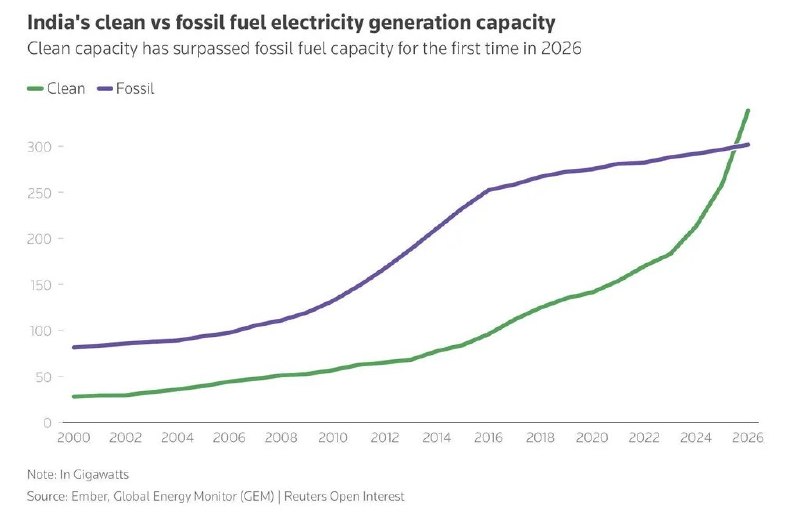
India's clean energy capacity has overtaken fossil fuels for the first time.According to the latest data from Ember and Global Energy Monitor, clean energy sources now total 331.7 gigawatts of installed capacity, compared with 302.0 gigawatts from fossil fuels. This marks the first occasion on which non-fossil sources have held the majority share of India’s utility-scale power capacity.Solar power accounts for the largest portion of the clean energy total, reaching approximately 211 gigawatts. Recent additions have been rapid: between 2025 and mid-2026 India installed nearly 80 gigawatts of clean capacity while fossil capacity grew by only about 5.4 gigawatts.Although coal plants continue to supply the majority of actual electricity generation because of their ability to operate continuously, the shift in installed capacity represents a significant milestone in India’s energy transition.Science and facts💡
Comments
Be the first comment