Bleached corals can recover within seven weeks after direct contact with healthy genetic clones of themselves.
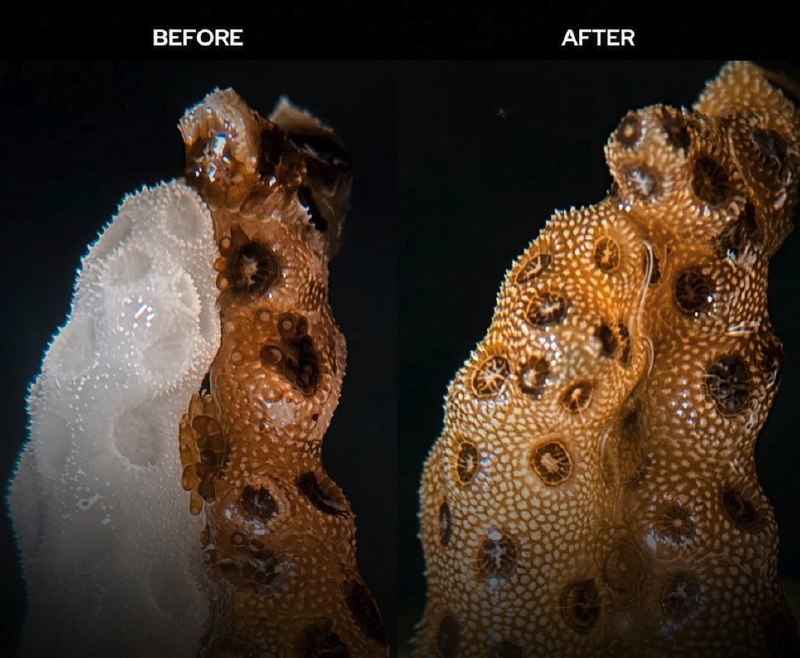
Bleached corals can recover within seven weeks after direct contact with healthy genetic clones of themselves. The observation began accidentally in a Stanford laboratory when two fragments from the same colony tipped over and touched. One fragment was healthy and the other was bleached, yet color began returning to the bleached tissue at the point of contact.That chance event led researcher Danny Collins to conduct controlled tests with ten pairs of coral fragments, each consisting of one healthy piece and one bleached clone from the same colony. Five pairs were placed in physical contact, while five pairs were held slightly apart. Within seven weeks, every bleached fragment in the touching pairs recovered fully, whereas the fragments kept separated died.The recovery occurred because the genetically identical fragments fused at the contact site, creating tissue connections through which beneficial symbiotic algae and nutrients moved from the healthy coral into the bleached partner. These microscopic algae normally provide a substantial portion of a coral’s energy. When heat stress causes corals to expel them, the animals turn pale and become vulnerable to starvation, although bleaching does not mean a coral is already dead.The researchers observed algae transferring into bleached fragments within three days. In additional experiments, roughly one week of contact, and in some cases as few as three to five days, supplied enough algae for recovery to continue after the fragments were separated, as the transferred algae multiplied rapidly inside the recipient tissue.Published in Science Advances, the findings indicate a potential pathway for accelerating recovery after marine heat waves. At present, however, the approach requires a healthy genetic match for each bleached coral, which limits its practicality for restoring entire reefs. The next step is to develop methods for delivering beneficial algae without placing a living clone beside every damaged colony.Assisting corals to recover could strengthen restoration efforts, yet it would not shield them from subsequent heat waves or reduce the need to slow ocean warming.[Collins, D. S., Sipkova, J., Mollica, N. R., Rolander, T., Klepac, C. N., Calistro, G. F., Barone, V., Micheli, F., & Palumbi, S. R. (2026). Rapid coral bleaching recovery via symbiont transfer from healthy corals. Science Advances, 12, eaeh1580. DOI: 10.1126/sciadv.aeh1580]Science and facts💡
Comments
Be the first comment