Scientists have determined that Vincent van Gogh’s masterpiece The Starry Night depicts a real sky observed on July 22, 1889.
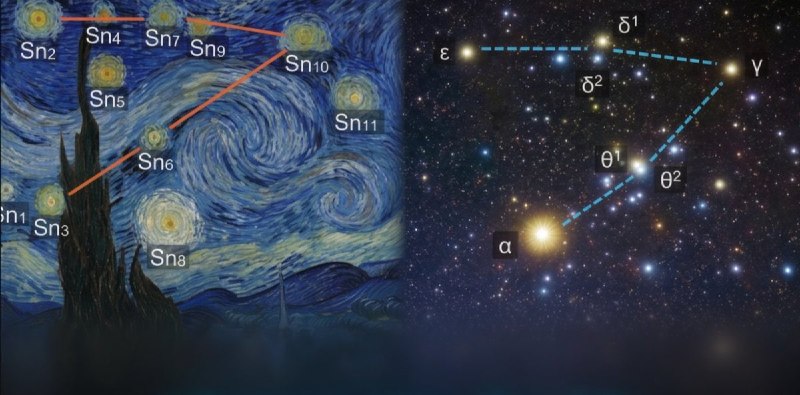
Scientists have determined that Vincent van Gogh’s masterpiece The Starry Night depicts a real sky observed on July 22, 1889. For decades, art historians and viewers regarded the painting primarily as an imaginative expression, created in mid-June 1889 while the artist stayed at the Saint-Paul-de-Mausole asylum in Saint-Rémy-de-Provence. A team of researchers using advanced computer simulations and historical astronomical data has challenged this long-standing view.By mapping the precise alignment of the crescent moon, Venus, and the Hyades star cluster, the researchers found that the painting’s celestial composition mathematically and geometrically matches the predawn sky visible from the artist’s window on July 22, 1889. This finding indicates that *The Starry Night* was an exaggerated interpretation of observed reality rather than a work born purely from imagination and internal turmoil. Although Van Gogh’s letters from mid-June mention early ideas for a night sky, the astronomical evidence suggests he likely finalized the painting more than a month later.By showing how accurately Van Gogh recorded real cosmic details alongside his distinctive swirling brushwork, the study reframes one of modern art’s most celebrated works, connecting artistic emotion with physical observation.[Kim, E. J., Kang, S., Song, J., & Jin, H. (2026). The actual sky of Van Gogh’s Starry Night: a multidisciplinary reconstruction. *Scientific Reports*. DOI: 10.1038/s41598-026-73025-5]Science and facts💡
Comments
Be the first comment